
You pull the grill cylinder out of the shed for the first cookout of the season, and it hits you: you have no idea how old this thing is, or whether it’s even safe to fill. You’re not alone, it’s one of the most common questions we field at the counter.
A propane tank doesn’t “expire” the way milk does. Instead, the collar carries a qualification period that tells you when the cylinder needs requalification. Once that period ends, a filling station cannot legally refill the tank until a qualified professional re-inspects or retests it. Age isn’t the only concern, either. If rust, deep dents, or a faulty valve have damaged the tank, a filler should not refill it even if the qualification period hasn’t ended.
Where to Look, and What You’re Actually Looking For
This is different from the large above-ground or underground propane tanks used for whole-home heating, which are inspected and maintained differently by your propane provider. For homeowners using either type of system, following propane tank safety practices is essential to keep the tank, connections, and surrounding area safe.
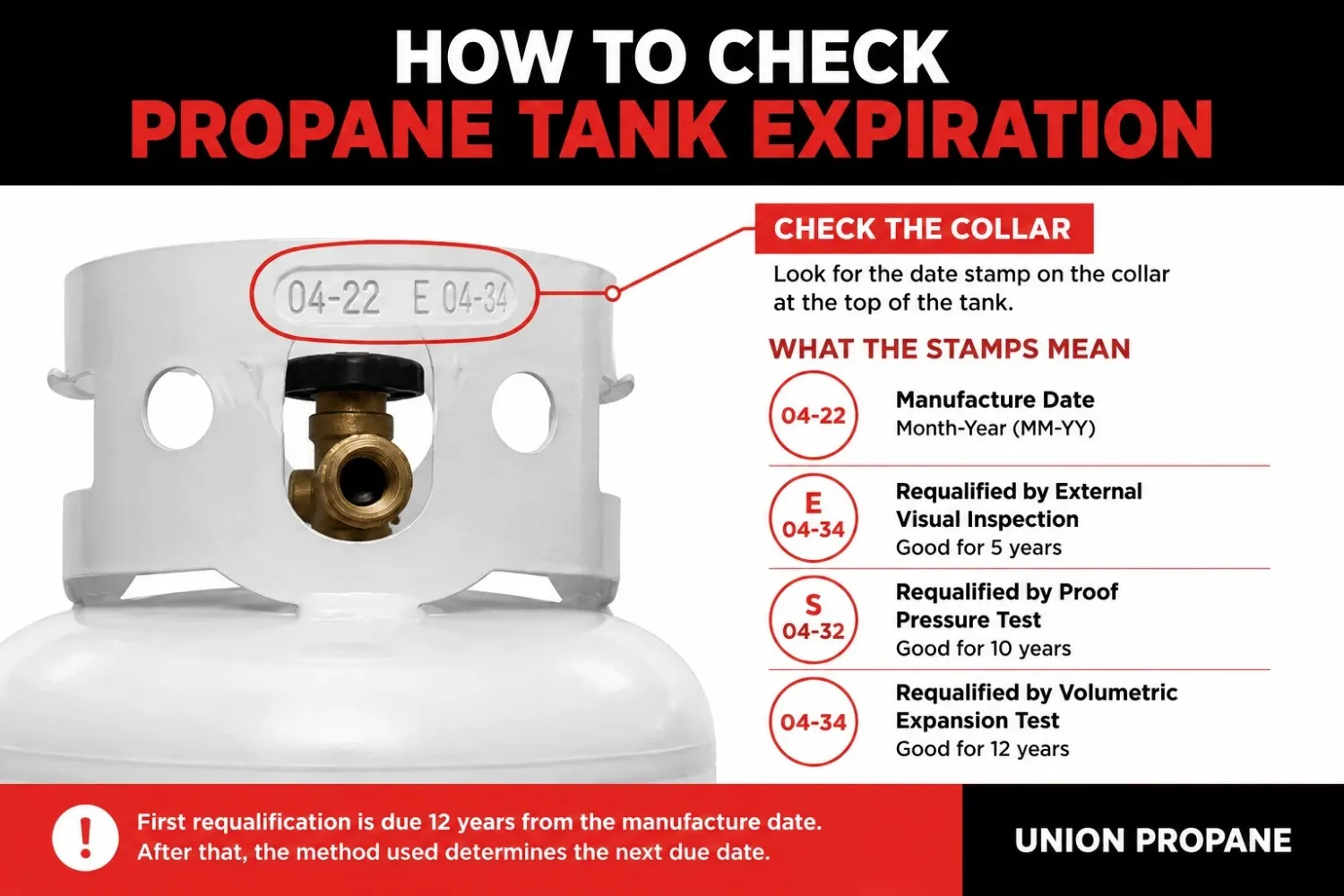
On the collar, you’ll typically see a two-digit month and two-digit year, something like 04-22. That’s the manufacture or original test date April 2022 in this example. If the cylinder has since been requalified, you’ll also see a second stamp with a letter attached to it:
- E requalified by external visual inspection (generally good for 5 years from that stamp)
- S requalified by proof-pressure testing (generally good for 10 years)
- No letter, just a date requalified by volumetric expansion testing (generally good for 12 years)
The first requalification for a standard cylinder is due 12 years after the original manufacture date.
The mistake we see most often: someone finds a stamp, assumes it’s automatically good for another five years, and doesn’t check which letter, if any, is actually next to it. That single letter changes the math completely, so it’s worth looking twice.
The Three-Step Check We Walk Customers Through
- Find the original date. Look around the collar for the earliest stamped month and year. That’s your starting point.
- Look for a later requalification stamp. If more than 12 years have passed since manufacture, check for a second, more recent date and note the letter next to it, since that tells you the real expiration window.
- Look at the tank itself, not just the numbers. A cylinder with a valid date but heavy rust, deep pitting, a dented body, or a damaged valve shouldn’t be filled either. Federal guidance is explicit that fillers are supposed to turn away cylinders in that condition, current stamp or not.
If any of this still feels uncertain the stamp is worn, you can’t tell which letter it is, or you’re just not confident reading it. That’s a completely normal thing to bring to a propane pro rather than guess. We check tanks like this at our shop every week, and it takes about two minutes.
What Happens If You Try to Fill an Overdue Tank
An overdue cylinder isn’t a paperwork technicality filling stations aren’t permitted to refill it. If you show up with one, you’ll either be turned away or told it needs to go through requalification first. That’s not a reflection of the propane itself being unsafe; it’s about whether the container is currently certified to hold pressure safely.
This is also where the propane tank exchange vs refill decision comes in for grill owners. If your tank is overdue and you don’t want to deal with requalification, an exchange program will simply swap it for a currently certified one on the spot which is often the fastest fix if you’re heading into a weekend and don’t want to lose a cookout to a stamp on a collar.
Does an Expired Tank Mean the Propane Inside Is Bad?
No and this is worth repeating because it’s the most common misconception we hear. The date on the collar is about the container’s certification, not the fuel. Propane itself doesn’t degrade on a shelf-life timer. The question is never “is the gas still good,” it’s “is this specific cylinder still legally and safely fillable.”
That distinction matters most for the tank that’s been sitting behind the garage for a few years. Before you reconnect it to a grill, check the stamp and the condition not because the propane went bad, but because the tank’s eligibility may have quietly lapsed while it sat there.
What to Do With a Tank That’s Overdue or Damaged

Don’t put it in the trash, leave it sitting somewhere unattended, or try to fix a valve yourself. Instead:
- Keep it away from any ignition source
- Don’t attempt a DIY repair on the valve or body
- Don’t try to refill it yourself or ask a filler to “just top it off”
- Have a qualified propane provider evaluate it for requalification
- If it can’t be safely requalified, ask what disposal or exchange options are available
If you’re just not sure what a stamp means, snap a clear photo of the collar markings and bring it in or send it over. It’s a five-minute answer for someone who reads them daily.
When Replacement Makes More Sense Than Requalification
Not every older tank needs to be replaced, that’s the whole point of requalification, it exists to let eligible cylinders keep going. But replacement is usually the more sensible call when there’s serious corrosion, a bent or bulging body, or a valve that isn’t sealing properly. In our experience, a tank that fails on physical condition almost never makes financial sense to push through requalification anyway.
If you’re weighing whether to fix, requalify, or just start over with your home tank setup, our team can walk you through it as part of a broader propane consultation. We’ll look at your actual equipment rather than guess from a description over the phone.
A Two-Minute Check You Can Do Right Now
Grab the cylinder, find the collar, read the earliest date, look for a follow-up stamp and its letter, glance over the tank for rust or dents, and you’ll know exactly where you stand. It’s a far more reliable habit than eyeballing a tank and assuming it’s “probably fine” because it still looks shiny.
For grill owners specifically, it also helps to know your options if the check doesn’t go your way our guide on where to fill a grill propane tank near me covers what to look for in a filling location, and current propane fuel costs are worth a look if you’re deciding between a refill and a straight exchange.
FAQs
Q.1 Does a propane tank expire?
Not in the way food does. The propane itself doesn’t have a shelf-life expiration the cylinder does, based on its manufacture date and any later requalification stamps.
Q.2 How do I know if my propane tank needs to be recertified?
Check the collar for the original manufacture date, then look for a later requalification stamp with a letter (E, S, or none). The letter tells you the applicable timeframe from that stamp.
Q.3 Is it illegal to fill an expired propane tank?
An overdue DOT cylinder shouldn’t be refilled, and licensed fillers are required to verify the markings and condition before topping one off.
Q.4 What does the “E” mean on a propane tank?
It indicates the cylinder was requalified using an external visual inspection, typically valid for five years from that stamp.
Q.5 What does the “S” mean on a propane tank?
It indicates requalification by the proof-pressure method, typically valid for ten years from that stamp.
Q.6 Can an old propane tank be recertified?
Often, yes as long as it passes inspection or testing. Tanks with serious corrosion or damage are usually the exception and may need to be retired instead.
Check It Before You Take It to Be Filled
Skip the guessing game. It takes less time than the drive to the filling station.
If you’d rather have someone else take a look, Union Propane has been a locally owned, Union County propane provider for years, and checking a cylinder’s markings and condition is something our team does routinely for grill tanks, home systems, and everything in between. For a deeper background on keeping your setup safe overall, our essential propane safety tips for homeowners guide is a good next read.