

You’re standing in your kitchen on a January evening in central Ohio, and midway through cooking dinner, your stove sputters out. The tank’s empty, nd you had no idea it was even close. Sound familiar?
One Union Propane customer in Marysville shared almost this exact story: she hadn’t checked her tank gauge in weeks and only realized it was empty when she went to cook dinner. After that, she signed up for autofill and hasn’t had the problem since.
A 250-gallon propane tank is one of the most common tank sizes for smaller Ohio homes. But “how long it lasts” depends entirely on what you’re running and how hard Ohio winters hit. Let’s break it down honestly.
A 250-gallon propane tank holds roughly 200 usable gallons (due to the 80% fill rule). Depending on your appliance load:
- Light use (stove, water heater only): 6–10 months
- Moderate use (heat + cooking + water): 2–4 months in winter
- Heavy heating use: 1–2 months during peak Ohio cold
That’s the range. Now, let’s talk about why it varies so much, because that’s where most homeowners get tripped up.
Why You Only Get 200 Gallons
Here’s something most people don’t fully understand until their first fill-up propane tanks are never filled to 100% capacity.
The industry-standard 80% fill rule exists because propane expands with heat p to 17 times its liquid volume as vapor. That 20% headspace is a safety buffer, not a rip-off. On a 250-gallon tank, that means your actual usable fuel tops out around 200 gallons per fill.
Fill above that, and you risk a pressure relief valve activation, not just a scary noise, but a real safety event. (There are documented cases of homeowner-owned tanks being overfilled and triggering the relief valve; it’s more common than people realize.)
So when you’re doing the math on “how long will this last,” always calculate from 200 gallons, not 250.
Propane Usage by Appliance

This is where you need to get specific. Here’s a realistic breakdown of daily propane consumption by appliance:
Furnace (80,000–100,000 BTU)
A mid-sized home furnace burns roughly 1 gallon per hour when actively running. In an Ohio winter where lows in Marysville, Columbus, and Delaware regularly drop into the teens, a furnace might run 8–12 hours per day during cold snaps. That’s 8–12 gallons per day. Over 30 days, you’re looking at 240–360 gallons for heat alone.
That math alone tells you: if you’re using a 250-gallon tank for primary home heating in Ohio, you will refill frequently in winter.
Water Heater
A standard 40-gallon propane water heater uses around 250–300 gallons of propane per year, approximately 20–25 gallons per month. Not huge, but meaningful on a smaller tank.
Stove
Daily cooking burns approximately 5–10 gallons per month. Relatively minor unless you’re cooking multiple meals from scratch every day.
Propane Fireplace:
A gas fireplace running a few hours daily can use 50–200 gallons per heating season, depending on BTU output and usage frequency.
Generator
This is the wild card. A 22kW standby generator burns roughly 2–3 gallons per hour under load. A 24-hour power outage during an ice storm, common in central Ohio, can consume 50–70 gallons in a single event.
Real Customer Usage Examples
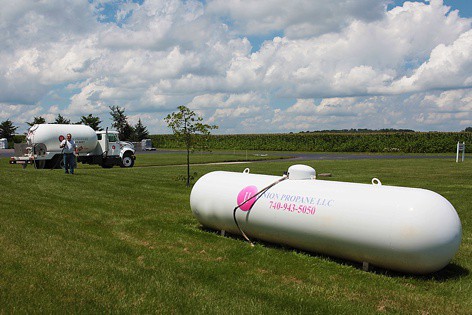
The Stove-and-Water-Heater Household: A couple in a smaller home using propane only for a stove and water heater. Total monthly usage: 25–35 gallons. A full 200-gallon supply lasts them roughly 6–8 months. They might refill once a year.
The Partial-Heat Home: A 1,500 sq. ft. home with a propane water heater, stove, and a supplemental fireplace (not primary heat). Winter usage climbs to 60–80 gallons per month. They’ll need 2–3 fills per heating season.
Primary Heating in Ohio Winters: A family using propane as the main heat source in a 1,800–2,000 sq. ft. home near Marysville. January and February alone can drain 150–180 gallons. A single 250-gallon tank may last only 5–6 weeks during peak cold. This is the profile where most homeowners are surprised by how quickly the tank empties.
Reddit threads are full of Ohio and Midwest users asking, ” Is it normal to refill my 250-gallon tank every month in winter?” and yes, if you’re heating a home, it absolutely can be.
Common Mistakes That Empty Your Tank Faster Than Expected
- Assuming the 250-gallon label means 250 usable gallons: Already covered, but this miscalculation alone catches a lot of first-time propane users off guard.
- Using a 250-gallon tank as a primary heat source for a larger home: A 250-gallon tank is generally suited for homes under 1,500 square feet using propane for full heating, or for larger homes using propane for secondary appliances only. If your home is 2,000+ square feet and relies on propane heat, consider whether a larger tank size would better match your actual usage pattern.
- Not accounting for generator use: Many Ohio homeowners add a propane standby generator after a bad ice storm season without recalculating their tank needs. Running a generator during a multi-day outage can wipe out what felt like “weeks of reserve.”
- Ignoring a small, persistent leak: One homeowner refilled their 250-gallon tank three times in 18 months with what seemed like light usage (daily stove, occasional fireplace). Eventually, a technician found a loose fitting at the pressure regulating valve. Propane has a strong odorant added specifically so you can detect a leak if you smell it near appliances when nothing’s running; that’s worth a service call, not just an open window.
- Never sign up for autofill or monitoring: Running out completely isn’t just inconvenient; it can require a pressure test and relight before service is restored, adding time and cost. Signing up for automatic delivery based on degree-day calculations or tank monitors eliminates the guessing.
Is a 250-Gallon Tank Right for You?

A 250-gallon tank is a solid fit if you’re running two to three appliances (stove, water heater, dryer) without primary home heating, or if you’re heating a modest home under 1,200–1,500 sq. ft. with relatively mild usage patterns.
For whole-home heating in central Ohio, where winters routinely bring extended cold stretches, most homeowners with average-sized homes are better served by a 500-gallon tank. It means fewer deliveries, often better per-gallon pricing on larger fills, and significantly more buffer during January cold snaps when delivery windows can stretch out.
If you’re not sure which size fits your home, a quick conversation with your propane supplier based on your actual square footage, appliance list, and average usage is the fastest way to get a real answer.
A 250-gallon propane tank typically lasts:
|
Usage Type |
Monthly Consumption | Tank Duration |
|
Light Use |
25–40 gallons | 6–10 months |
| Moderate Use | 60–100 gallons |
2–4 months |
| Heavy Use | 150–300 gallons |
1–2 months |
Ohio-Specific Usage Insights
Ohio winters don’t follow a tidy schedule. Marysville, Dublin, Marion, and surrounding areas can see sustained cold spells where temperatures stay below 20°F for days at a stretch. During those periods, a furnace doesn’t cycle; it runs. And a tank that felt comfortable at the start of January can drop fast.
New customers to propane sometimes expect it to behave like a monthly utility bill, predictable and even. The reality is more seasonal. You’ll use a fraction of your annual fuel from May through September, and the bulk of it from November through March.
Planning around that rhythm, whether through autofill, monitoring, or simply scheduling a fill in October before prices and demand climb, makes the experience significantly smoother.
FAQ
1. How many gallons of propane does a home use per month in winter?
For a home using propane primarily for heating, expect 100–200 gallons per month in winter, depending on home size, insulation, and temperature. Homes using propane only for cooking and hot water use far less, typically 25–40 gallons monthly.
2. Why does my propane tank seem to empty faster than my neighbor’s?
Appliance load, home size, insulation quality, thermostat settings, and whether you’re running a generator all factor in. If your usage seems abnormally high compared to similar homes, it’s worth having a technician check for leaks at connections and appliances, not just at the tank.
3. Can I fill a 250-gallon propane tank full?
No, and you shouldn’t. Propane expands with heat, so tanks are filled to 80% of capacity by regulation and for safety reasons. On a 250-gallon tank, that means a maximum of about 200 gallons per fill.
4. How often should I refill a 250-gallon propane tank?
It varies. Light appliance users might refill once or twice a year. Homeowners using propane for primary heating in Ohio may refill every 4–8 weeks during winter. Signing up for automatic delivery removes this concern entirely.
5. Is a 250-gallon tank large enough for a whole house?
It depends on the house and your propane usage. For homes under 1,200–1,500 sq. ft. with moderate heating needs, it can work. For larger homes or those with high heating demand, a 500-gallon tank typically provides better efficiency and fewer supply interruptions.
The Bottom Line
A 250-gallon propane tank can last anywhere from a few weeks to nearly a year, and both answers are correct depending on what you’re running and when. The key is matching your tank size to your actual usage, not just your address.
If you’re not sure whether your current tank is sized right for your home, or you’d like to explore delivery options in the Marysville area and surrounding Ohio communities, the propane tank size page is a good place to start.
Reach out directly to talk through your setup__


