
You’ve decided propane is the right energy source for your home, especially in Ohio, where winters are unpredictable and reliable heat matters. However, now comes the question most homeowners never expected to research: which propane tank installation is actually right for their property?
Should you go with an above-ground or underground propane tank installation?
It sounds like a small detail. It isn’t. The type of installation you choose affects your installation timeline, long-term maintenance, yard appearance, and how easy it is to get your tank serviced during a February cold snap.
At Union Propane, we’ve been helping Ohio homeowners from Marysville to Columbus to the surrounding rural communities make this exact decision for over 16 years. Here’s what we’ve learned from installing and servicing hundreds of residential propane systems across Central Ohio.
Quick Answer
- Above-ground propane tank installation is faster, easier to maintain, and more accessible for technicians, making it the practical choice for most Ohio homeowners.
- Underground propane tank installation keeps your property looking clean and protects the tank from surface weather, the better choice when appearance or HOA rules matter.
- Neither is inherently safer than the other; both are equally safe when installed by experienced, licensed propane tank installers.
Why Columbus-Area Homeowners Are Rethinking Their Energy Setup Right Now
You noticed higher heating bills this winter because natural gas rates across Central Ohio rose sharply after Winter Storm Fern. As a result, many homeowners in Columbus, Dublin, Hilliard, Grove City, and Westerville faced significantly higher heating costs during the 2025–2026 season.
That’s the current reality for homeowners relying on natural gas from the utility in the Columbus area. And it’s one of the main reasons we’ve seen a noticeable uptick in calls from homeowners asking about residential propane tank installation as an alternative or as a backup heating and generator fuel source.
Propane isn’t tied to the same utility infrastructure as Columbia Gas. If you own or lease your tank, you control your supply, and you’re not subject to the same rate volatility that comes with being on the default utility grid. For homeowners in outlying communities around Columbus, Marysville, Delaware, Marion, and beyond, where natural gas lines don’t even reach, propane has always been the practical answer. But this past winter pushed a lot of suburban Columbus homeowners into the same conversation. So if you’re reading this because recent heating bills prompted a rethink, you’re not alone.
What Is an Above-Ground Propane Tank Installation?
An above-ground propane tank sits on a level, stable surface, usually a gravel bed or concrete pad, and is visible on your property. Most residential above-ground setups use:
- 250-gallon tanks for supplemental heating, cooking, or fireplace use
- 500-gallon tanks the most common size for whole-home residential heating in Ohio
- 1,000-gallon tanks for larger homes, farms, or combined heating and generator systems
These tanks are straightforward to install, easy to access during delivery, and simple to inspect. If you’re planning a propane generator hookup alongside your home heating system, an above-ground tank is typically the most practical choice because technicians can quickly connect, test, and service everything without any excavation.
What Is an Underground Propane Tank Installation?
An underground propane tank is buried below the surface of your yard, with only a small dome-shaped access cover visible above ground. The tank itself functions identically to an above-ground model; it stores propane, connects to your home’s gas lines, and feeds your heating system, water heater, kitchen appliances, or backup generator. The difference is entirely in the installation process and what you see (or don’t see) from your backyard.
Underground installations require:
- A site inspection and soil assessment
- Excavation to the correct burial depth
- Cathodic protection to prevent corrosion over time
- Proper backfilling and landscaping restoration
- Final safety checks and pressure testing before the system goes live
Our team at Union Propane handles every step of this process, including any permits required in your specific Ohio county or municipality.
Side-by-Side Comparison: Above Ground vs Underground
|
Factor |
Above Ground | Underground |
|
Installation time |
Faster | Longer (excavation required) |
| Upfront installation complexity | Lower |
Higher |
|
Visibility on the property |
Visible | Hidden below grade |
| Maintenance access | Easy |
Requires digging for major repairs |
|
Weather exposure |
Some surface exposure | Naturally insulated by soil |
| HOA compatibility | Sometimes restricted |
Usually accepted |
| Best for | Most Ohio residential homes |
Appearance-focused or HOA-regulated properties |
The Real Deciding Factors for Ohio Homeowners
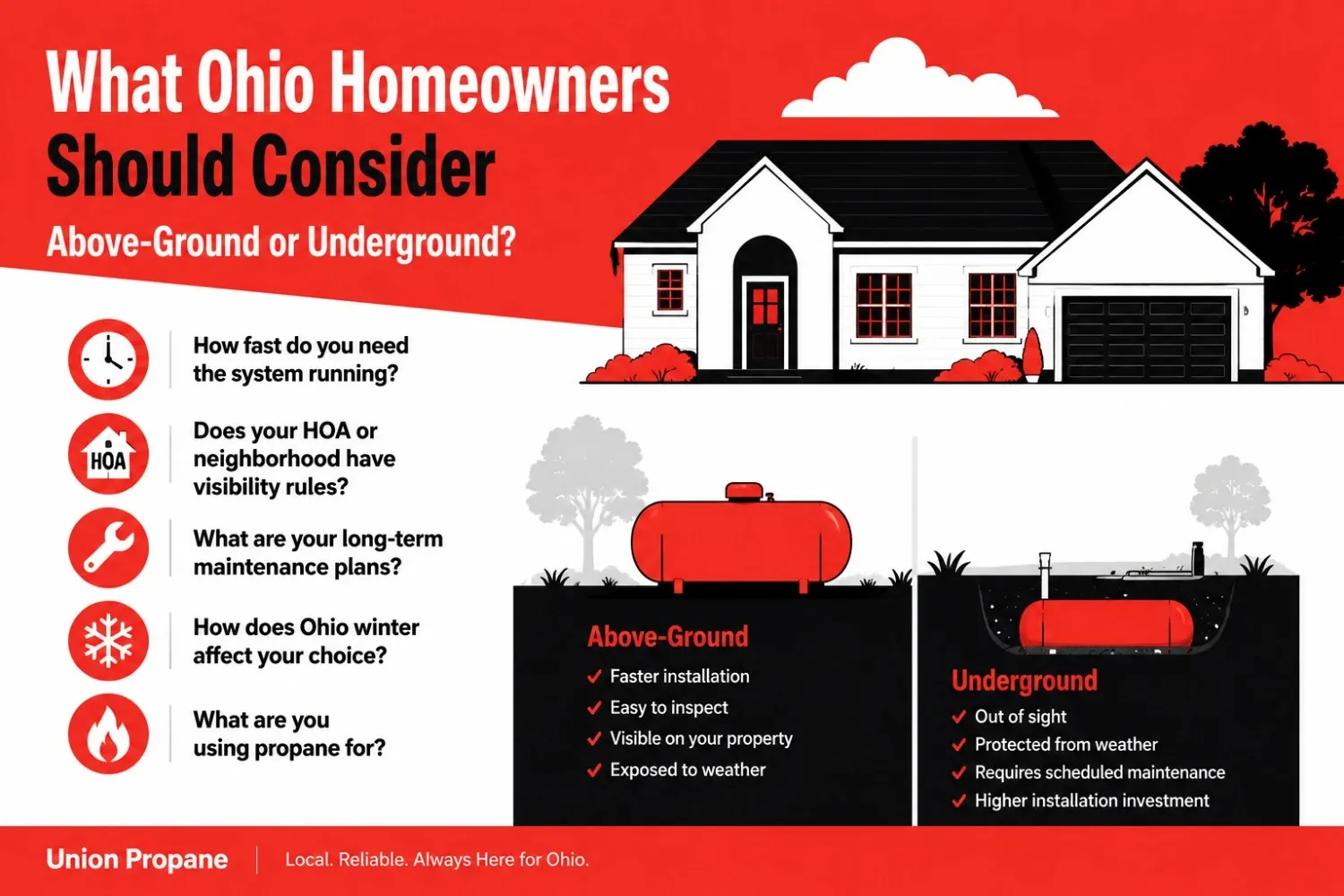
1. How Fast Do You Need the System Running?
If you’re moving into a new home before winter, installing propane for a backup generator ahead of storm season, or converting from electric heat, on a deadline, above-ground installation is almost always faster.
There’s no excavation. Site preparation is minimal. In many situations, our team can complete an above-ground residential propane tank installation in a single visit. Underground systems require coordination across multiple days, including permitting in some areas, excavation, and backfill work.
2. Does Your HOA or Neighborhood Have Visibility Rules?
This is one of the most common reasons Ohio homeowners near Columbus choose underground installations. Many newer planned communities and subdivisions have aesthetic requirements that prohibit visible propane tanks. If your HOA has these rules or if you’re simply building or renovating a home where curb appeal matters, an underground tank is usually the cleaner solution.
That said, if you’re on a rural property or acreage where your propane tank placement isn’t a visual concern, the extra investment in hiding the tank underground may not add any meaningful benefit to you.
3. What Are Your Long-Term Maintenance Plans?
This is where above-ground tanks have a clear practical advantage that homeowners sometimes overlook at the research stage. Above-ground propane tanks are easy to inspect during every delivery. Our drivers can visually check the tank condition, spot early signs of rust or valve wear, and flag anything that needs attention, all during a routine fill. This is especially helpful in Ohio winters when catching a minor issue early can prevent a major service disruption.
Underground tanks require more deliberate maintenance scheduling. They’re not visible during standard deliveries, so issues can go unnoticed until they become larger problems. Cathodic protection, the system that prevents buried tank corrosion, needs periodic inspection and testing. These aren’t reasons to avoid underground installation; they’re just factors to account for in your long-term maintenance expectations.
If you want proactive monitoring regardless of which tank type you choose, Union Propane’s tank monitoring services can track your propane levels in real time and schedule deliveries automatically so you’re never caught off guard when temperatures drop.
4. How Does Ohio Winter Affect Your Choice?
Here’s something competitors often gloss over: Ohio winters are not gentle on above-ground equipment. Extreme cold doesn’t affect propane itself; it’s stored as a liquid under pressure, and properly maintained tanks perform well in sub-zero temperatures. However, above-ground tanks are exposed to snow, ice, and freeze-thaw cycles that can affect valves, regulators, and external fittings over many years.
Underground tanks avoid this entirely. The surrounding soil acts as natural insulation, and the tank exterior is protected from surface weather. For homeowners planning a long-term installation on a property they expect to own for decades, this is a real consideration. That said, what matters more than tank location for Ohio winter performance is tank size and delivery reliability. A homeowner who has a properly sized propane tank and a dependable delivery schedule will have far fewer problems than someone who guessed wrong on size, regardless of whether the tank is above or below ground.
5. What Are You Using Propane For?
This matters more than most comparison articles acknowledge.
- Whole-home heating → A 500-gallon above-ground or underground tank is typically the right starting point for most Ohio homes
- Whole-home heating plus backup generator → Consider a 1,000-gallon tank or dual-tank setup; discuss your specific usage with our team
- Supplemental use (cooking, fireplace, water heater only) → A smaller above-ground system may be perfectly sufficient
- Agricultural or farm use → Above-ground bulk tanks are standard for this application
If you’re planning a propane-powered backup generator as part of your installation, review our generator hookup services page. This integration affects both which tank size makes sense and where it should be positioned on your property.
A Common Scenario We See in Ohio
A family moves into a home on a few acres outside of Columbus. They want propane for whole-home heating, a whole-home generator, and their kitchen range. They’re not in an HOA. Their backyard is large, and the tank won’t be seen from the road. In this situation, we almost always recommend above-ground installation. It’s faster to set up before winter, easier to service, and the practical benefits of going underground don’t apply to their specific property or lifestyle.
Now compare that to a homeowner in a newer subdivision near Dublin or Hilliard, Ohio. Their HOA prohibits visible propane tanks. They’re building a custom home and want a clean, landscaped backyard. Here, underground installation is the clear choice; it’s the only option that fits both their community rules and their aesthetic goals. There’s no universal “right answer.” The right answer depends on your property, your priorities, and how you plan to use propane long-term.
Why Working With Local, Experienced Installers Matters
We’ve seen what happens when homeowners try to save money by working with installers who aren’t familiar with Ohio’s specific requirements. Permits get missed. Installations don’t meet local setback rules. Tanks get placed in locations that make delivery or maintenance unnecessarily difficult.
Union Propane has been locally owned and operated in Marysville, Ohio, for over 16 years. Dean Cook, Brian Phelps, Doug Phelps, and Alan Phelps built this company around the idea that propane service should feel like getting help from a neighbor, not a transaction with a faceless national chain. To learn more about who we are and how we operate, visit our About Union Propane page.
Frequently Asked Questions
Q.1 Is underground propane tank installation safe?
Yes. Underground propane tank installation is considered very safe when completed by licensed, experienced installers following Ohio safety codes. The tank includes cathodic protection to prevent corrosion, and the installation process includes pressure testing before the system is activated.
Q.2 How do I know what size propane tank I need for my Ohio home?
Tank size depends on how many appliances you’re running off propane, your home’s square footage, and whether you’re also running a backup generator. Visit our propane tank sizes page for a detailed breakdown, or contact us directly, and we’ll help you calculate the right size for your specific home.
Q.3 Can I switch from above-ground to underground propane tank installation later?
Yes, but it involves a full new installation, removal of the above-ground tank, and excavation for the underground system. It’s more economical to make the right choice upfront. If you’re uncertain, our team can walk through your property and help you decide before any work begins.
Q.4 Does Union Propane handle all permits for propane tank installation?
Our team is familiar with permitting requirements across our Central Ohio service area, including Marysville, Columbus, Delaware, Marion, Clark, and London. We handle the coordination needed to make sure your installation is compliant from the start.
Q.5 What happens if I run out of propane in winter?
This is one of the most common calls we receive between December and February. If you’re an existing Union Propane customer, contact us immediately through our customer portal or by calling 937-644-2452. We also strongly recommend setting up automatic delivery through our tank monitoring service so your tank level is tracked in real time and refills are scheduled before you’re ever in a low-fuel situation.
Q.6 Does propane work well for backup generators in Ohio winters?
Absolutely. Propane-powered generators are an excellent choice for Ohio homeowners because propane stores indefinitely, and unlike gasoline, it does not suffer from fuel degradation over time. In addition, propane remains available even when severe winter storms close roads and disrupt fuel deliveries. As a result, homeowners can rely on a steady backup power source during emergencies. Learn more about our generator hookup services and discover how we seamlessly integrate generator systems with your propane tank installation.
Ready to Choose the Right Propane Tank Installation for Your Ohio Home?
If you’re still weighing above ground vs underground, or if you’re ready to move forward and want a local team who knows Ohio properties inside and out, we’re here to help. Union Propane serves homeowners and businesses across Marysville, Columbus, Delaware, Marion, Clark, London, and surrounding Central Ohio communities. Or contact our team online, and we’ll help you figure out exactly which propane tank setup makes the most sense for your home, your property, and your Ohio winter.